

How to decide what leaves your wardrobe
Keep, rediscover, sell or give. A calm, honest way to decide what stays and what goes, without regret, guilt or a mountain of clothes on the bed.
By Chloé Sasaa · 27 October 2026 · 11 min read
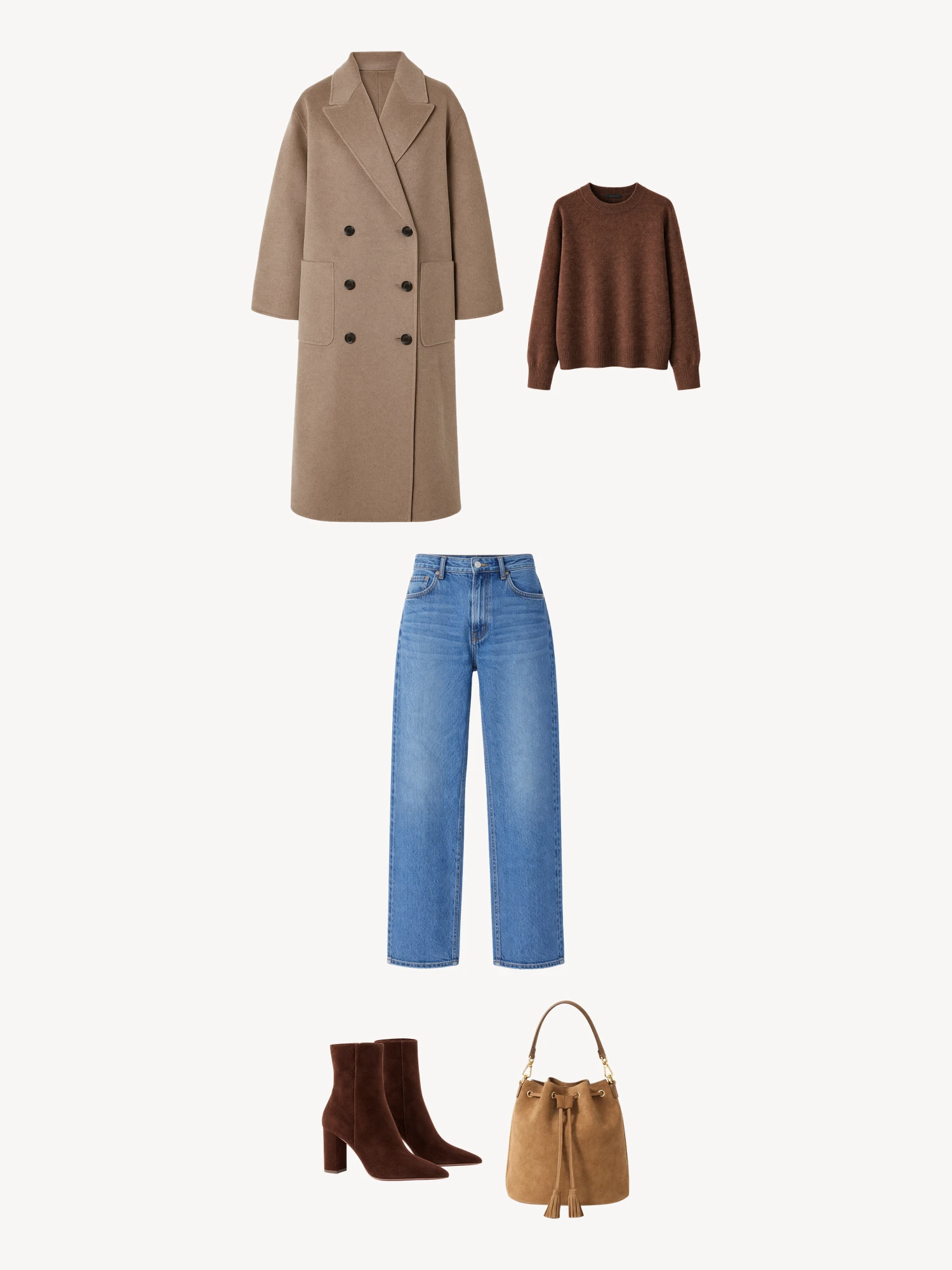
Taupe coat, brown knit, jeans, brown ankle boots and a suede bucket bag.
Decluttering advice usually starts with a dramatic moment. Take everything out. Pile it all on the bed. Hold each piece and ask yourself a big question. Be ruthless. Fill bags. Feel lighter.
For some people, that works. For many of us, it ends with an exhausted evening, a mountain of clothes on the bed that has to be moved before we can sleep, and a few bags by the door that sit there for weeks. Sometimes we even regret what we gave away.
I’d like to suggest a calmer approach. One that’s less about being ruthless and more about being honest. Less about getting rid of as much as possible, and more about making sure every piece ends up in the right place, whether that’s your wardrobe or someone else’s.
Because deciding what leaves your wardrobe isn’t really about having less. It’s about having clothes that work for you, and making sure the ones that don’t get a good second life.
Because deciding what leaves your wardrobe isn’t really about having less.
Four paths, not two
Most decluttering advice offers two choices: keep or get rid of. But that’s too simple. It misses the pieces that are worth keeping but need something first, and it treats everything that leaves as the same.
Instead, think of four paths every piece can take.
Keep. It works, you wear it, it belongs in your life.
Rediscover. You like it, but you don’t wear it. It needs a partner, a repair, or just to be seen again.
Sell. It doesn’t belong in your life, but it’s in good condition and has value. Someone else would wear it and be glad to.
Give. It doesn’t belong in your life, and the best home for it is with a friend, someone in need, or a good charity.
And for pieces that are truly worn out, a fifth path: recycle, properly, so the fabric can be used again.
Thinking in these paths takes a lot of the pressure out of decluttering. You’re not deciding whether to keep or lose something. You’re deciding where it belongs.
Start small
You don’t need to do the whole wardrobe at once. In fact, it’s usually better not to.
Choose one small area: one drawer, one section of the rail, one category like shoes or knitwear. Give yourself half an hour. When the time is up, stop, even if you haven’t finished.
Small sessions are easier to start, easier to finish, and less likely to end in regret. You make better decisions when you’re not tired. And you don’t end up with a bed covered in clothes at midnight.
The questions that help
As you look at each piece, a few simple questions help you find its path.
When did I last wear it? If it’s been more than a year, ask why. You’re in good company: WRAP, the UK’s waste and resources programme, found in 2012 that around 30 per cent of the clothing in people’s wardrobes hadn’t been worn for at least a year. Not wearing something isn’t a crime. But it’s worth understanding.
Does it fit my body as it is now? Not as it was, not as it might be. Now.
Does it suit my life as it is now? The work you do, the places you go, the weather where you live.
Do I like how I feel in it? Not whether it’s nice, but whether you feel like yourself.
Is it in good condition? Or could it be, with a small repair?
Would I buy it again today? A surprisingly useful question. If the answer is a clear no, that tells you something.
You don’t need to answer every question for every piece. Usually one or two make the path clear.
Keep
Pieces you wear and love, that fit and suit your life, go straight back. Don’t overthink them.
This includes pieces you wear only occasionally but genuinely need. A warm coat for the coldest weeks. Something smart for formal events. Clothes for a sport or hobby you actually do. Occasional doesn’t mean unnecessary.
It also includes the pieces that carry your history. The coat that belonged to someone you loved, the shirt from an important day, the jumper with years of memories in it. These don’t need to earn their place by being worn often. They belong to you in a different way. Keep them, and keep them somewhere you can see them sometimes.
Rediscover
This is the most interesting path, and the one most decluttering advice skips.
Some pieces you don’t wear aren’t pieces you don’t want. They’re pieces that need something.
They need a partner. A top you love but never know what to wear with. Try it with the things you wear most. Often a piece becomes easy once it has a good match.
They need a repair. A missing button, a loose hem, a small tear. Put these in a pile and deal with them together. A single afternoon of repairs can bring several pieces back.
They need to be seen. Pieces at the back of the wardrobe or bottom of a drawer simply get forgotten. Move them to the front.
They need a new context. The dress saved for best could be worn on an ordinary day. The formal shirt could be worn open over a T shirt.
Give rediscover pieces a time limit. Put them somewhere visible for a few months. If you wear them, wonderful, they’re back. If you don’t, they can move to another path next time.
Sell
Pieces in good condition that don’t belong in your life anymore often have real value to someone else.
Selling is a good path for clothes that are well made, in good shape and still in demand. It gives them a new life with someone who will wear them, and gives you something back.
A few tips:
Clean and check them first. Wash, press and look for any small faults. Fix what you can.
Be honest about condition. Buyers appreciate it, and it saves disappointment.
Be realistic about effort. Selling takes time. For pieces of modest value, giving might be simpler and just as good.
Set a deadline. If a piece hasn’t sold after a few weeks, move it to the give path. A bag of things waiting to be sold can sit by the door for months, and that helps nobody.
Give
Giving is a lovely path for clothes that will be welcomed by someone else.
Friends and family. Often the best home of all. You know the person, you know they’ll wear it, and you might even see it again.
Local organisations. Some community groups, shelters and charities welcome specific kinds of clothing. It’s worth checking what they actually need, so your donation helps rather than creates more work.
Charity shops. A good option for clothes in good condition.
It’s worth being honest about one thing. Giving clothes away doesn’t make them disappear, and not everything given can be worn again. The European Environment Agency reports that the European Union exports about 1.4 million tonnes of used clothing a year, up from around 550,000 tonnes in 2000. Some of it finds new wearers. Not all of it does.
So give thoughtfully. Clothes in good, wearable condition, to places that can use them. And for pieces that are truly worn out, choose recycling instead.
Recycle
When a piece is genuinely beyond wearing, with holes, stains or wear that can’t be fixed, look for proper textile recycling rather than the bin.
Many areas have textile recycling points, and some shops take worn clothes back. Recycling isn’t perfect, but it’s far better than landfill, and it keeps fabric in use.
The pieces you’re unsure about
Some pieces won’t fit neatly into any path. You don’t wear them, but you’re not ready to let go.
That’s fine. Put them in a box, label it with a date a few months ahead, and put it somewhere out of the way. If you find yourself missing something, take it out and wear it. When the date arrives, look at what’s left. Usually the decision feels much easier by then.
This takes the fear out of decluttering. Nothing is gone for good until you’re sure.
Pieces you were given
Gifts can be the hardest clothes to decide about. Someone chose them for you, and letting them go can feel like letting that person down.
It helps to remember that the gift was the thought, and you received it. The garment itself was meant to make you happy. If it doesn’t, and never will, keeping it out of guilt doesn’t honour the giver. Passing it on to someone who will love wearing it might honour them more.
Of course, if a gift carries real meaning, it belongs with the pieces that carry your story, and those stay. The question is simply whether this one does.
Doing it with someone
Some people find deciding much easier with a friend beside them. A good friend can tell you honestly whether something suits you, remind you how often they’ve seen you in it, and keep you company through the harder decisions.
Choose someone who knows your style and respects it, rather than someone who will push you towards their own taste. And remember you have the final say. They’re there to help you see clearly, not to decide for you.
The feelings that come up
It’s worth saying that decluttering can stir up more feeling than expected. Clothes hold memories, hopes and old versions of ourselves. A dress bought for a life you imagined. Trousers from a body you used to have. A jacket from a job you left.
If a session becomes heavy, stop. There’s no deadline. Come back another day, perhaps to a different drawer. Going gently is not a failure. It’s often the reason the decisions you do make are ones you won’t regret.
Avoiding regret
People sometimes regret decluttering when they move too fast. A few things help.
Don’t declutter when you’re upset. Big decisions made in a bad mood are often regretted.
Don’t let go of things just because of a rule. “If you haven’t worn it in a year, get rid of it” ignores seasonal clothes, occasional clothes and meaningful clothes.
Keep what carries your story. Pieces with deep meaning are rarely regretted when kept, and often regretted when given away.
Take your time. Small, regular sessions are better than one big purge.
After the decluttering
Once you’ve decided what leaves, your wardrobe will usually feel lighter and easier to use. You can see what you have. Getting dressed is simpler.
To keep it that way, a few habits help.
Think before you buy. The fewer things come in, the less needs to go out.
Do small check ins. Once a season, look at one area of your wardrobe and ask the same questions.
Keep a rediscover space. A small section for pieces you want to bring back into rotation.
Where Chloé comes in
Deciding what leaves is much easier when you can see everything you own, and that’s where WATOWEAR helps.
When your clothes are in the app, they’re all in one place you can see and search. And Chloé builds outfits from your whole wardrobe, so the pieces you’ve been unsure about get a chance. If she suggests a forgotten piece and you love it, it’s back. If even she can’t make it work for you, that’s useful to know when you decide its path.
The right place for every piece
Deciding what leaves your wardrobe doesn’t have to be dramatic or ruthless. It can be calm, honest and kind, to yourself and to your clothes.
Keep what works. Rediscover what’s been hiding. Sell or give what belongs with someone else. Recycle what’s truly worn out. And keep the pieces that carry your story, always.
Every piece deserves a place where it’ll be worn. Sometimes that’s your wardrobe. Sometimes it’s someone else’s.
- WRAP, Valuing Our Clothes, 2012, consumer research with 7,950 UK adults: about 30 per cent of clothing unworn for at least a year.
- European Environment Agency, 2023: the European Union exports about 1.4 million tonnes of used clothing a year, up from around 550,000 tonnes in 2000.