

Should I buy it? Five questions before you do
A quick, honest test you can run in the shop or with something in your basket. Including the question most of us skip: what job does this do that nothing I own already does?
By Chloé Sasaa · 27 October 2026 · 11 min read
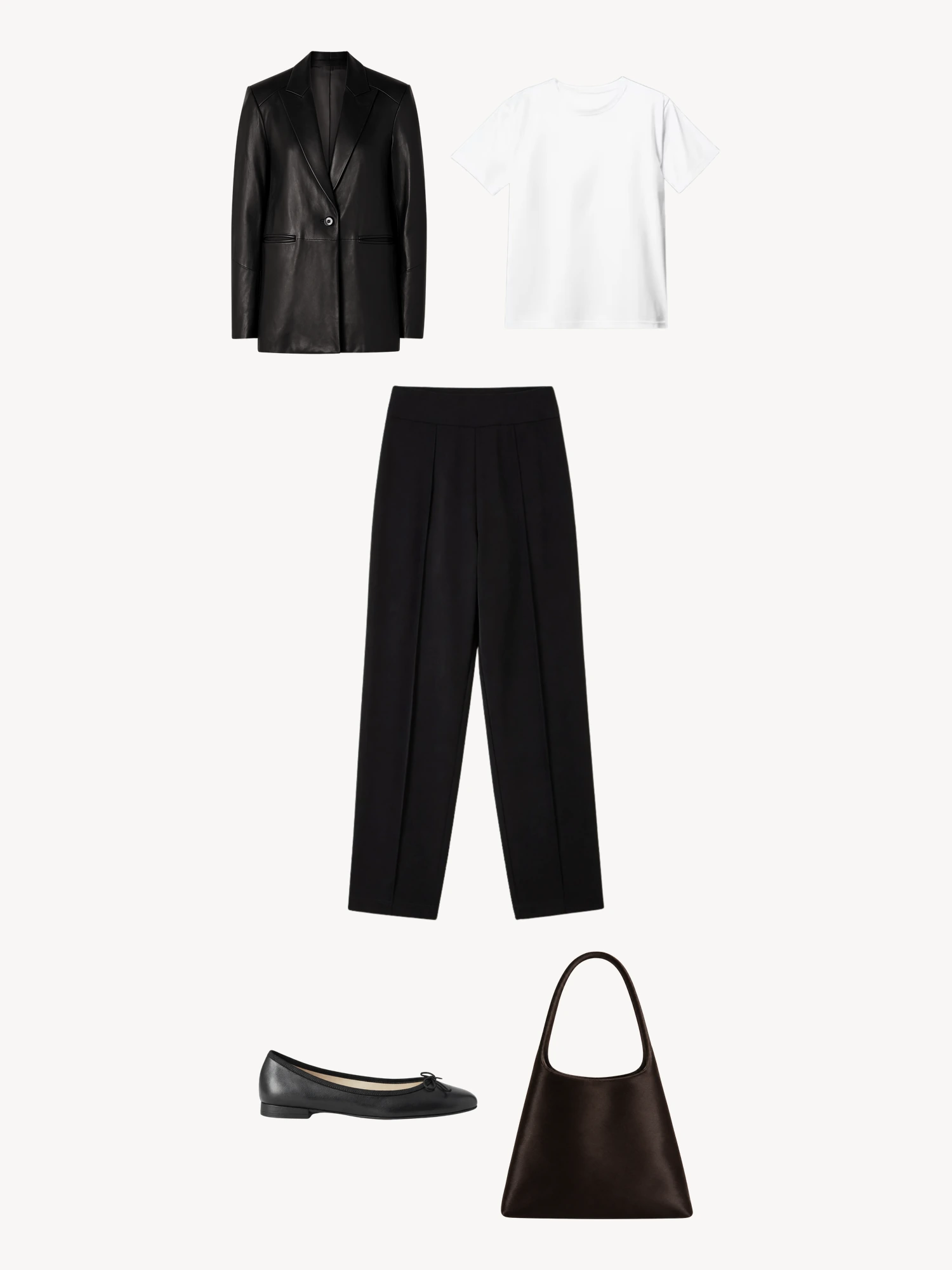
Black leather blazer, white tee, black trousers, ballet flats and a dark tote.
You know the moment.
You’re in a changing room, or more likely on your sofa with your phone, and there it is. The jacket. The perfect jacket. It’s in your basket, or over your arm, and you’re already imagining the version of your life where you wear it. In that life you are slightly more organised, your hair is doing what you asked it to, and you’re walking somewhere interesting with a coffee.
And a small voice asks: do I actually need this?
That voice deserves a better answer than “probably not” or “treat yourself”. Neither of those helps. One makes you feel guilty and the other makes you feel guilty a week later.
So here’s what I’d like to give you instead. Five questions. You can run through them in a couple of minutes, in a shop or at home. They won’t tell you never to buy anything, because that isn’t the point. They’ll help you buy the things you’ll love and wear for years, and walk past the things you’ll wear twice.
Because the idea I keep coming back to is simple. Buy to keep, not to throw away.
Buy to keep, not to throw away.
Why this is worth two minutes
We buy differently from how we used to. McKinsey looked at this in 2016, covering the years from 2000 to 2014, and found that the average shopper was buying about 60 per cent more clothing than at the start of that period, and keeping each piece about half as long.
More in, faster out. That isn’t because anyone decided to be wasteful. It’s because buying got easier and quicker, and the moment between wanting something and owning it shrank to almost nothing. A couple of taps and it’s on its way.
These five questions are a way of putting a little space back into that moment. Not a wall, just a breath.
Question one: what job does this do that nothing I own already does?
This is the most important question, so it goes first.
Every piece in a wardrobe has a job. Keeping you warm on a cold walk. Making you feel sharp in a meeting. Being the easy thing you throw on at the weekend. Dressing up a plain outfit for dinner.
Before you buy something, ask what its job would be. Then ask, honestly, whether something you already own does that job.
You might be surprised how often the answer is yes. The new black jumper does the same job as the black jumper you already have. The new white trainers do the same job as the white trainers by the door. Sometimes the new one is a little nicer, and that’s worth admitting. But a little nicer is rarely worth owning two of the same thing, especially when the first one is still perfectly good.
And when the answer is no, when this piece really would do something nothing else in your wardrobe can, that’s a strong sign. That’s a real gap, and real gaps are worth filling well.
Question two: can I picture three outfits with it, from what I own?
Not three outfits with other things you’d also have to buy. Three outfits with clothes that are already in your wardrobe right now.
This question catches a very common trap. A piece looks wonderful on its own, styled perfectly in a photo with the perfect trousers, the perfect shoes and the perfect bag. Then it comes home, and none of your clothes are those clothes. It sits on the rail, beautiful and lonely, waiting for an outfit that never arrives.
If you can picture it with three different things you own, it’s likely to become part of your life. If you can only picture it with one outfit, or with something you don’t have yet, be careful. You may be buying a whole new outfit without realising it, one piece at a time.
Question three: will I still want to wear this in two years?
Not whether it’ll still be in fashion. Fashion moves too quickly for that to be a useful test. The question is whether you’ll still want it.
Think about the pieces you’ve loved for years. They tend to have something in common. They fit well, they feel good, and they suit the way you actually live. They might be simple or they might be bold, but they’re genuinely yours.
Now think about the pieces you wore a few times and then forgot. They often have something in common too. You bought them because they were new, or exciting, or on someone else, or because you were having a hard day and wanted something to feel different.
There’s no shame in any of that. Everyone has done it. But if this piece feels more like the second group than the first, give it a day. If you still want it tomorrow, and the day after, that’s a much better sign than wanting it right now.
Question four: does it fit the body and life I have today?
Not the body you had a few years ago, and not the one you might have next summer. The one you have today. And not the life you imagine, with the dinner parties and the weekends away. The life you actually live, most weeks.
This question isn’t about being hard on yourself. It’s the opposite. Clothes bought for a different body or a different life tend to end up as a quiet reproach on the rail, and nobody needs that.
So try it on properly if you can. Sit down in it. Lift your arms. Walk a few steps. Ask whether you’d be comfortable in it for a whole day, not just for the length of a mirror. And ask whether it suits what your days are really made of. A beautiful piece you can only wear twice a year is a different decision from one you’d wear every week.
Question five: how will I look after it, and how long will it last?
This is the question we skip most, and it’s the one that matters most once the excitement has worn off.
Look at the fabric, the seams, the buttons. Read the care label. Will it survive being washed the way you actually wash things? Does it need dry cleaning you know you’ll never get round to? Does it look like it will still be in good shape after a year of regular wear?
A piece you can wear and wash and wear again for years is a very different thing from a piece that will look tired after a few outings. Buy to keep, not to throw away. If something is made to last, and you’ll care for it, it can become one of those pieces you reach for over and over.
And that matters more than it sounds. In 2012, WRAP, the UK’s waste and resources programme, found that keeping clothes in active use for just nine months longer cuts their carbon, water and waste footprints by 20 to 30 per cent each. Every extra season you get from a piece counts.
The answers, put together
You don’t need every answer to be a perfect yes. Life isn’t that tidy, and sometimes you just want something lovely. That’s allowed.
But here’s a rough guide.
Mostly yes: it does a job nothing else does, it works with what you own, you’ll still want it, it fits your real life and it’s made to last. Buy it, enjoy it, and wear it often.
Mostly no: it duplicates something you have, only works with things you don’t own, feels like a passing mood, doesn’t quite fit or won’t last. Walk away, and feel good about it. You haven’t missed out. You’ve kept space for something better.
Somewhere in the middle: wait. Leave it in the basket. Come back tomorrow. Very often the feeling fades, and you’ll be glad. And sometimes it doesn’t fade at all, and then you can buy it with a clear head.
When it’s in a sale
Sales deserve their own word, because they change how the questions feel.
A reduced price makes everything look like a good decision. The voice in your head stops asking “do I need this” and starts asking “can I afford not to”. And that second question is a clever one, because the answer always seems to be no.
So here’s a small trick. Imagine the piece at its full price. Would you still want it? Would it still pass the five questions? If yes, wonderful, the sale is a lovely bonus. If you’d only buy it because it’s reduced, then what you’re really buying is the feeling of a bargain, and that feeling tends to leave long before the piece does.
The best deal is still the thing you’ll wear a hundred times. Something you never wear costs too much at any price.
When it’s for one occasion
Weddings, parties, interviews, a big birthday. Sometimes we need something for one particular day, and that’s a real reason to shop.
Even here, the questions help. Before buying, look at your wardrobe with the occasion in mind. Very often you have most of an outfit already, and what’s missing is one piece, a pair of shoes, or simply a new way of putting things together.
If you do buy, choose something you can picture wearing again afterwards. A dress that works for a wedding and also for a dinner. A jacket that’s smart enough for the interview and relaxed enough for a Friday. The occasion is one day. The piece can have a much longer life than that, if you choose it for one.
A few tricks that help
The one day rule. For anything that isn’t urgent, give it a day. Wanting something today is a feeling. Still wanting it tomorrow is a decision.
Shop your wardrobe first. Before you go looking for something new, look properly at what you already have. The piece you’re thinking of buying might already be at the back of the rail.
Write down your real gaps. Keep a short note of things you genuinely need and keep missing. When you do shop, start there. It turns shopping from a mood into a plan.
Notice your triggers. Many of us shop more when we’re tired, stressed or bored. That’s human. Just knowing it helps you pause when you notice it happening.
Ask someone who knows you. A friend who has seen you in your clothes for years is often better at this test than any mirror. They know which pieces you actually wear, and they’ll usually tell you the truth, kindly.
Where Chloé comes in
This is exactly the kind of moment WATOWEAR was made for.
Because Chloé knows the clothes you already own, she can help with the hardest question, the first one. Show her the piece you’re thinking about, and she can tell you whether something in your wardrobe already does that job, and how the new piece would work with what you have. Sometimes the honest answer is that you already own it. Sometimes it’s that this would fill a real gap. Either way, you decide with more than a feeling to go on.
And when there really is something missing, the app can help you find it. If you buy through us we may earn a commission, and it never changes what you pay. But that’s the last step, not the first. The first is always your own wardrobe.
Buy to keep
None of this is about buying nothing. Clothes are one of the great pleasures of life, and getting something new that you truly love is a wonderful feeling.
It’s about buying in a way that you’ll still feel good about next year. Fewer pieces bought with more care. Things that do a real job, work with what you have, suit your real life, and last.
Buy to keep, not to throw away. Your wardrobe will thank you, and so will your mornings.
- McKinsey and Company, Style that’s sustainable: a new fast-fashion formula, 2016, covering 2000 to 2014: the average shopper buys about 60 per cent more clothing and keeps it about half as long.
- WRAP, Valuing Our Clothes, 2012, consumer research with 7,950 UK adults: nine months more wear cuts carbon, water and waste footprints by 20 to 30 per cent each.