

How to build a capsule wardrobe from clothes you already own
The honest version of the capsule wardrobe. No shopping list, no magic number of pieces. You start from your own shelves, and you end up wearing more of them.
By Chloé Sasaa · 27 October 2026 · 11 min read
If you’ve ever looked up how to build a capsule wardrobe, you’ll know how it usually goes.
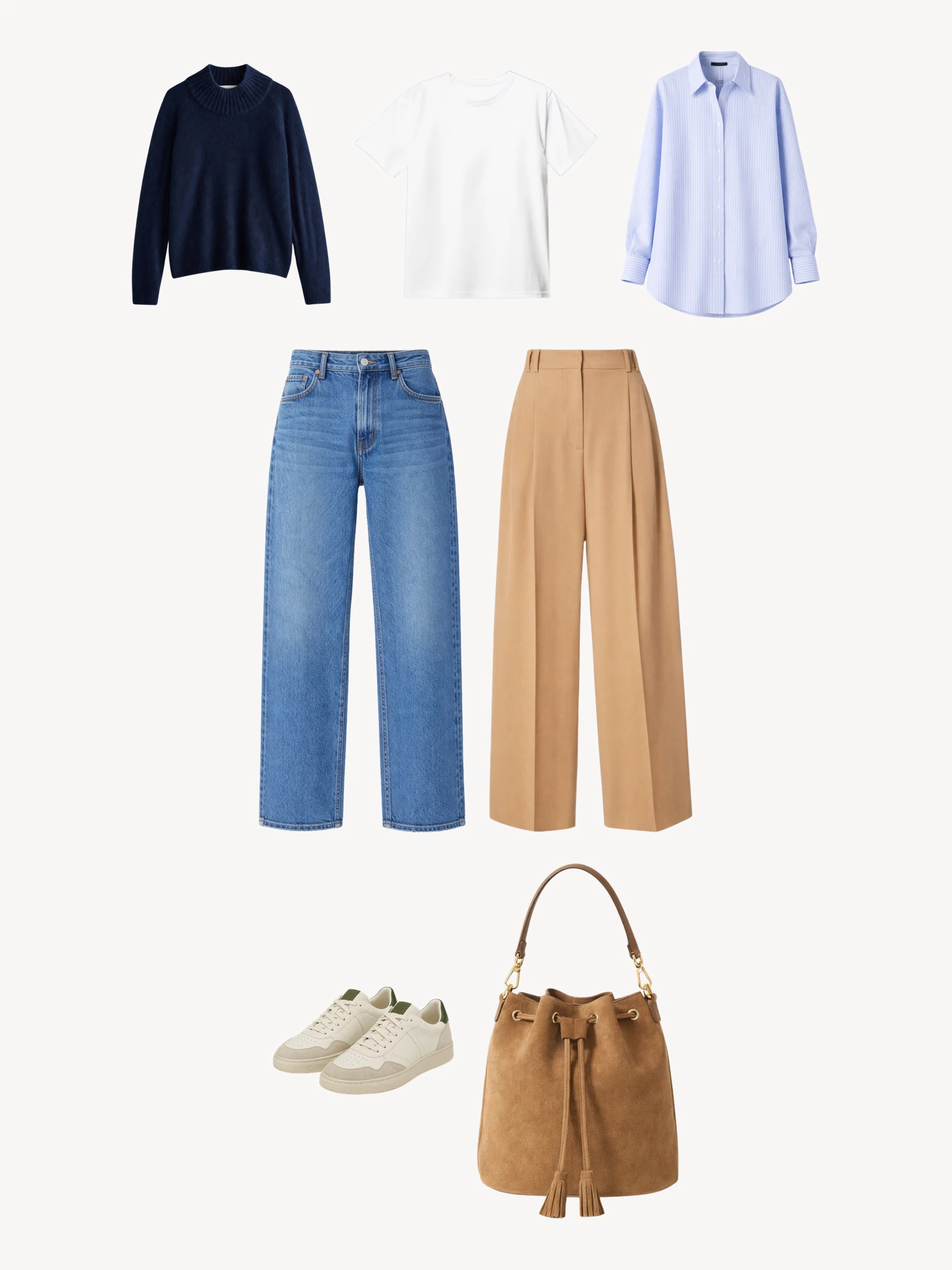
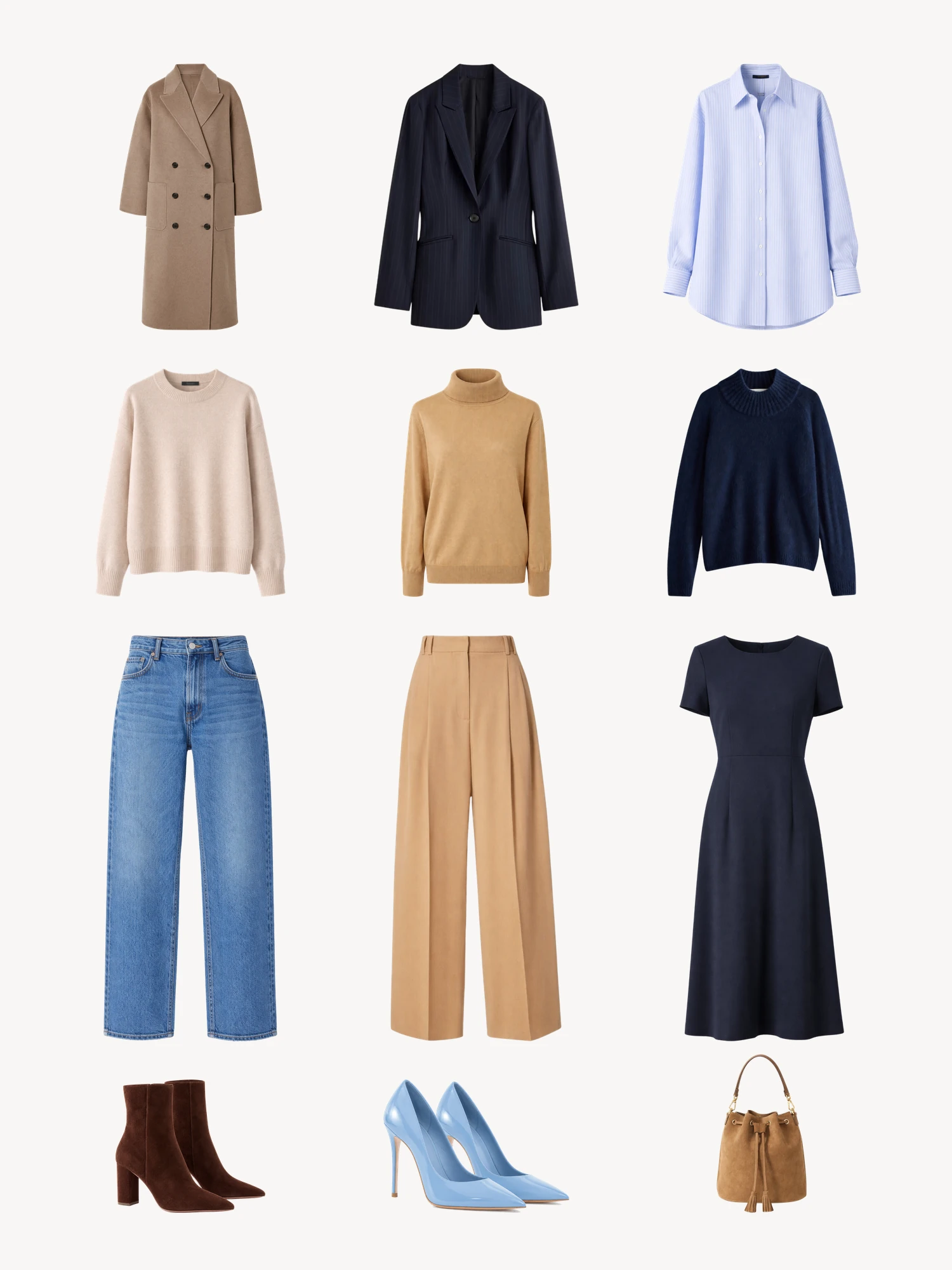
First, a beautiful photograph of about thirty perfect pieces in soft neutral colours, hanging at exactly equal distances on wooden hangers. Then a list. A white shirt, a camel coat, a navy jumper, the right jeans, the right trousers, the right trainers, the right bag. And then, somewhere near the bottom, a little row of links to buy all of it.
So the idea that was supposed to help you own less begins with a shopping trip.
I’d like to suggest a different way in. One where you don’t buy anything at all, at least not at first. One where the capsule comes out of the wardrobe you already have, because that’s where most of it has been all along.
What a capsule actually is
Let’s clear the ground first, because the word has collected a lot of rules over the years.
A capsule wardrobe is simply a small set of clothes that work well together. That’s it. The point is that almost every top goes with almost every bottom, that the layers sit happily over most of what’s underneath, and that the shoes don’t fight with anything. When a set of clothes works like that, a small number of pieces makes a surprisingly large number of outfits.
That’s the whole idea. It isn’t a number. It isn’t a colour palette you must obey. It isn’t a list of items that everyone is supposed to own. Your capsule doesn’t need a camel coat if you’ve never once felt like yourself in a camel coat.
A capsule also doesn’t have to be your whole wardrobe. It can be the clothes for a season. For a busy month at work. For a trip. For the next ten days. Think of it less as a lifestyle and more as a tool you pick up when it’s useful.
Why starting from your own clothes works better
There are three good reasons to build a capsule from what you already own, and only one of them is about money.
You already know these clothes. You know which trousers are actually comfortable after six hours. You know which shirt looks lovely and creases in ten minutes. You know which jumper you reach for every single cold morning. That knowledge is worth more than any list, because it’s yours.
There’s more in there than you think. In 2012, WRAP, the UK’s waste and resources programme, studied the clothing habits of nearly eight thousand adults. Around 30 per cent of the clothing in their wardrobes hadn’t been worn for at least a year. A capsule built from your own shelves is often the thing that brings some of that quiet third back to life.
It’s kinder, in every sense. The same WRAP research found that keeping clothes in active use for nine more months cuts their carbon, water and waste footprints by 20 to 30 per cent each. A capsule is, very simply, a way of wearing the things you own more often. That counts.
A capsule is, very simply, a way of wearing the things you own more often.
Before you begin: one honest look
You don’t need to empty the whole wardrobe onto the bed. Honestly, please don’t, unless you enjoy sleeping on the sofa. But it helps to take one calm look at what’s there before you start choosing.
Give yourself half an hour. Go through the rail and the drawers and, for each piece, ask one simple question: do I actually wear this, or do I just own it?
You’ll end up with three loose groups:
- The ones you wear all the time. These are the backbone of your capsule, and you probably already know what they are.
- The ones you like but rarely wear. These are the interesting ones. Often there’s nothing wrong with them at all, they just never found the right partner.
- The ones that don’t work any more. Wrong size, wrong life, wrong feeling. Set them aside for now. You don’t have to decide anything about them today.
The capsule comes mostly from the first group, with a few chosen pieces from the second. The third group doesn’t take part.
Step one: decide what it’s for
A capsule needs a purpose, because the purpose decides everything else.
Is it for the next season? For a month where work is busy and you don’t want to think about clothes at all? For a trip with one small bag? For the stretch of weeks when you’re mostly at home and want to feel put together without trying too hard?
Write it down in one line. Something like “the next six weeks of autumn, mostly office, a few dinners”. That one line will quietly answer a lot of questions later. It tells you how warm things need to be, how smart, how many shoes you really need, and whether that sequined top belongs here or can wait for another day.
Step two: find your anchors
Start with the pieces you already wear most for this kind of life. Two or three pairs of trousers, or skirts, or jeans, whatever your bottoms tend to be. A handful of tops you love. One or two layers. The shoes you actually walk in.
These are your anchors. They’re the clothes that already work for you, and they set the tone for the rest of the capsule.
Look at them laid out together. What colours keep coming up? What shapes? Are they mostly relaxed or mostly sharp? You’re not trying to change any of that. You’re just noticing the language your own clothes already speak, so that everything else you add speaks it too.
Step three: look for the connectors
Some pieces in every wardrobe are quiet heroes. They’re not exciting, and they’re rarely the thing you’d photograph, but they go with almost everything. A cardigan that sits nicely over every top. A pair of trousers that work with trainers and with smart shoes. A plain shirt that can be worn open, closed, tucked or layered.
These are connectors, and they’re the secret of a capsule that actually works. A connector multiplies everything around it. One good cardigan can make a whole row of tops wearable on cooler days. One pair of trousers in the right colour can pull a dozen tops into outfits.
Look through your second group, the pieces you like but rarely wear. Is there a connector hiding there? Often there is. It just never had a team to play for.
Step four: add a little life
A capsule made only of anchors and connectors can feel a bit like a uniform. That’s fine for some people, and lovely in its own way. But most of us want at least a little colour, a little texture, a little personality.
So add two or three pieces that you simply enjoy. A top in a colour that makes you feel bright. A pair of earrings that changes everything. A scarf, a bag, a jacket that you love to wear. These are what make the capsule feel like you and not like an instruction manual.
The test for each one is simple: does it go with at least two or three of your anchors? If it does, it earns its place. If it only works with one thing, it might be better saved for another time.
Step five: count the outfits, not the pieces
Here’s where capsules become a little bit magical.
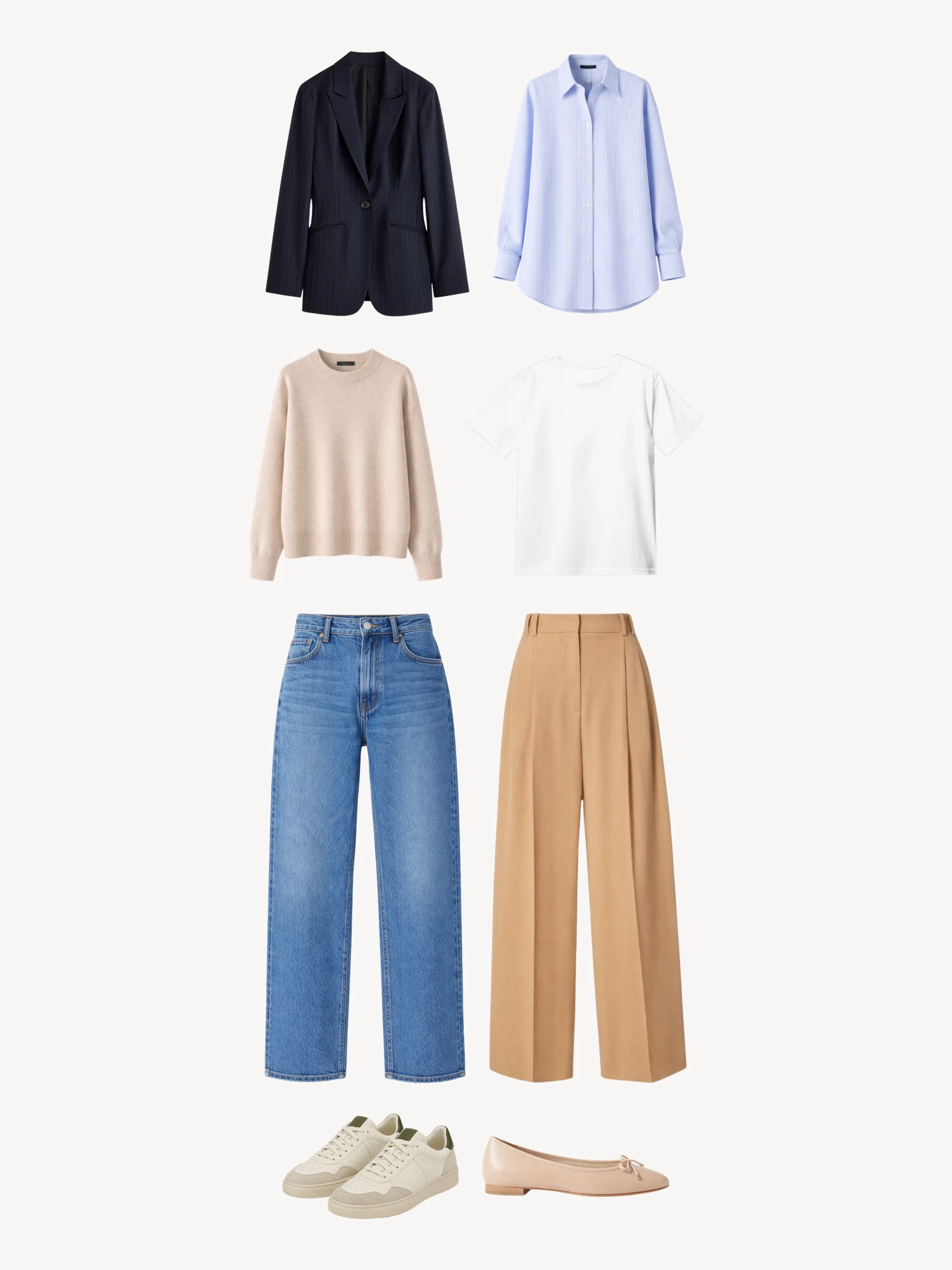
Take your set and start putting outfits together. Write them down, or take a quick photo of each one, or just try them in your head. Three bottoms and five tops already make fifteen combinations before you’ve added a single layer. Add two layers and some of those outfits change completely. Add a second pair of shoes and you have another set of options again.
You’ll probably find that a capsule of fifteen or twenty pieces makes far more outfits than you’d expect. You’ll also find, very quickly, which pieces aren’t pulling their weight. If a top only works with one bottom, or a pair of shoes only goes with one outfit, that’s worth knowing. Swap it for something from your wardrobe that connects better.
This is the moment where a lot of people get a pleasant shock. The clothes they already had, chosen with a bit of care, make more outfits than their entire overflowing wardrobe ever seemed to.
Step six: live in it for a while
Now wear it. For the whole period you planned, if you can.
Put the capsule somewhere easy to see, at the front of the rail or on its own little section, and let the rest of the wardrobe rest for a while. Mornings get noticeably simpler when there are fewer things to choose between and they all get along.
As you go, pay attention. Which pieces do you reach for every time? Which ones keep getting skipped? Is there an outfit you love so much you’ve worn it three times? Is there a gap that keeps showing up, like a layer for windy days or a pair of shoes for rain?
All of that is useful. It tells you how to make the next capsule even better, and it tells you a lot about your own style.
What to do when there really is a gap
Sometimes, living in a capsule shows you something real. You keep wanting a particular piece and you simply don’t own one. Maybe it’s a warm layer that isn’t a coat. Maybe it’s trousers you can comfortably sit in all day.
If the same gap keeps coming back, it’s probably genuine. And the good news is that because you’ve built a capsule, you know exactly what the missing piece needs to do. It needs to go with your anchors. It needs to suit the life you wrote down in step one. It needs to be something you’ll wear many times, not just once.
A specific gap is easy to fill well. A vague feeling of needing something new is very easy to fill badly. A capsule turns one into the other.
A few things capsules are not
Because the idea has picked up so many rules, it’s worth saying what you don’t have to do.
You don’t need an exact number of pieces. Ten is fine. Forty is fine. The right number is whatever makes your life easier.
You don’t need to wear only neutrals. If your favourite colour is bright green, a capsule full of bright green is a perfectly good capsule.
You don’t need to get rid of everything else. The rest of your wardrobe can simply rest while you live in the capsule. Plenty of it will come back next season.
You don’t need to buy anything to start. That’s the whole point of this article, and it bears repeating.
Where Chloé comes in
Capsules are one of my favourite parts of WATOWEAR, because they turn this whole process into something lighter.
Once your clothes are in the app, you can build a capsule for a week, a trip or a season from the pieces you already own. Chloé can help you choose the pieces that work together and suggest outfits from that small set, so you can see how much a few well chosen clothes can do. If you’re packing, the capsule can become your packing list.
And because she starts from your own wardrobe, not from a shop, the first answer to “what goes in my capsule” is always something you already have.
The quiet benefit
There’s one more thing capsules do, and it’s easy to miss.
When you live in a small, well chosen set of clothes for a while, you start to see your own style more clearly. You notice what you love and what you were only keeping out of habit. You notice which pieces you’d replace in a heartbeat if they wore out, and which you wouldn’t miss at all.
That clarity stays with you long after the capsule is over. It makes every future decision about clothes a little easier, a little calmer, and a lot more like you.
So start with what you have. Choose with care. Count the outfits. And see how much your own wardrobe has been waiting to give you.
- WRAP, Valuing Our Clothes, 2012, consumer research with 7,950 UK adults: about 30 per cent of clothing unworn for at least a year; nine months more wear cuts carbon, water and waste footprints by 20 to 30 per cent each.