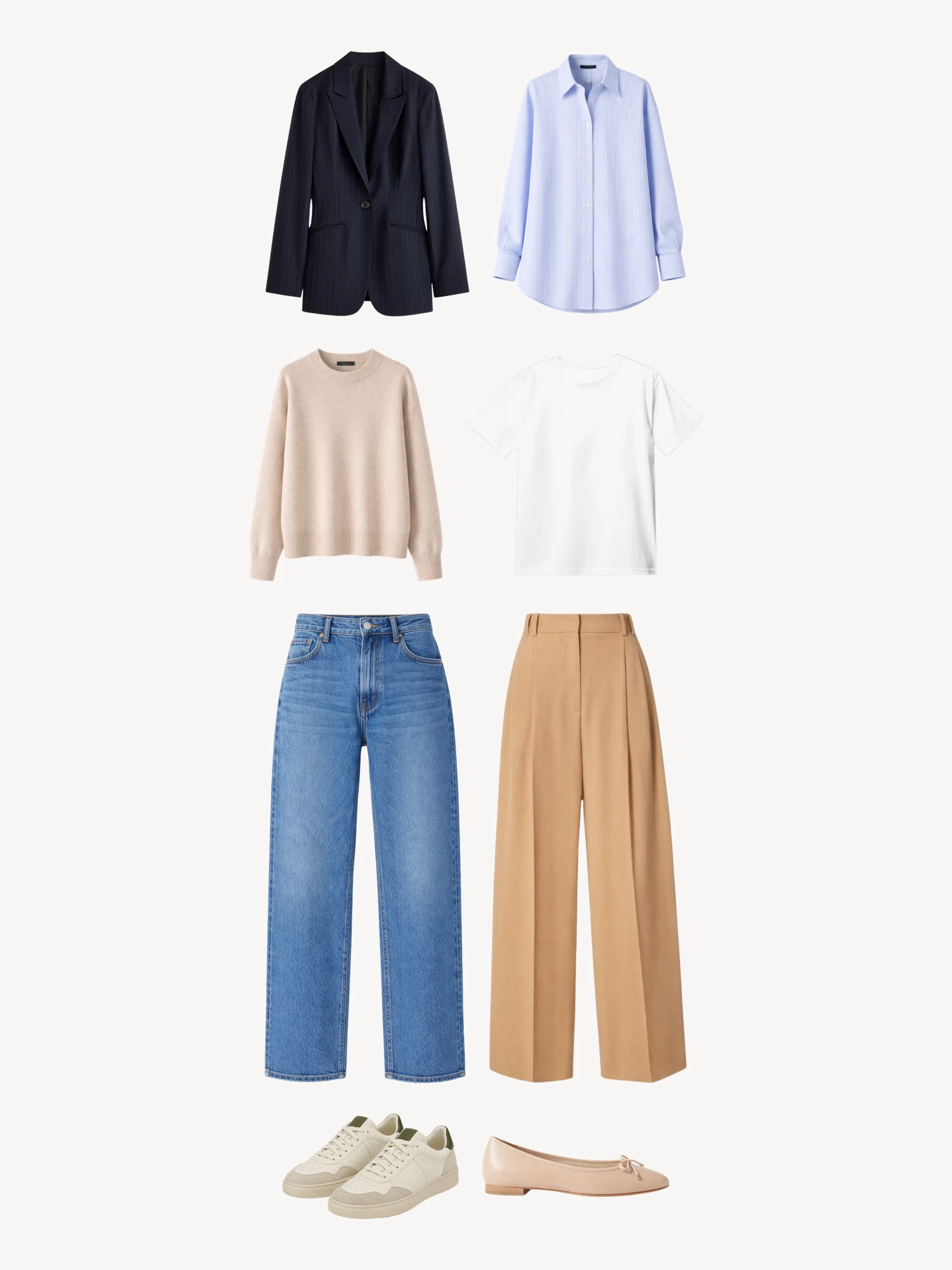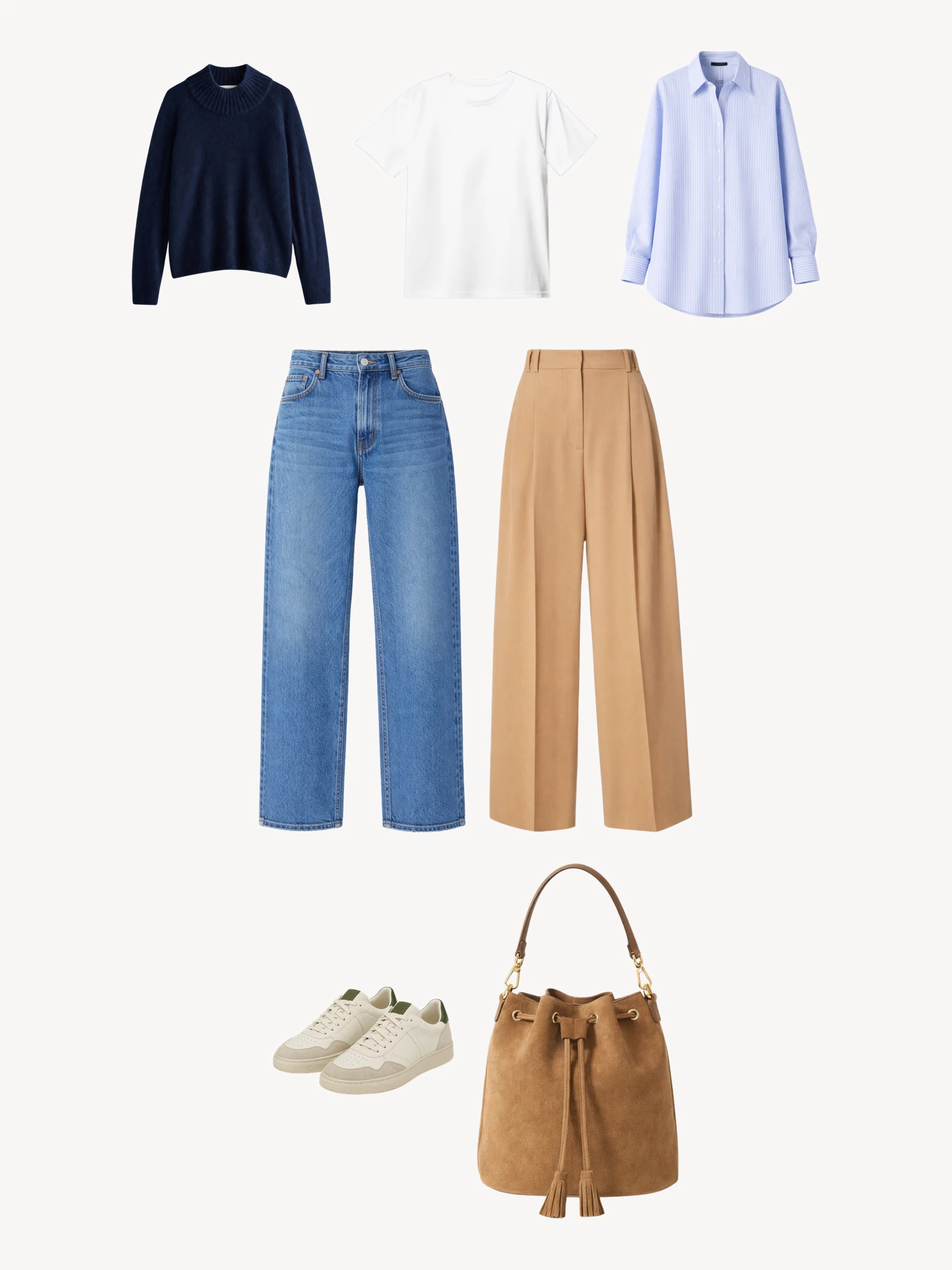


The ten day capsule: fewer pieces, more outfits
A worked example. Twelve real pieces, the outfits they really produce, and ten days of getting dressed without repeating a single look.
By Chloé Sasaa · 27 October 2026 · 11 min read
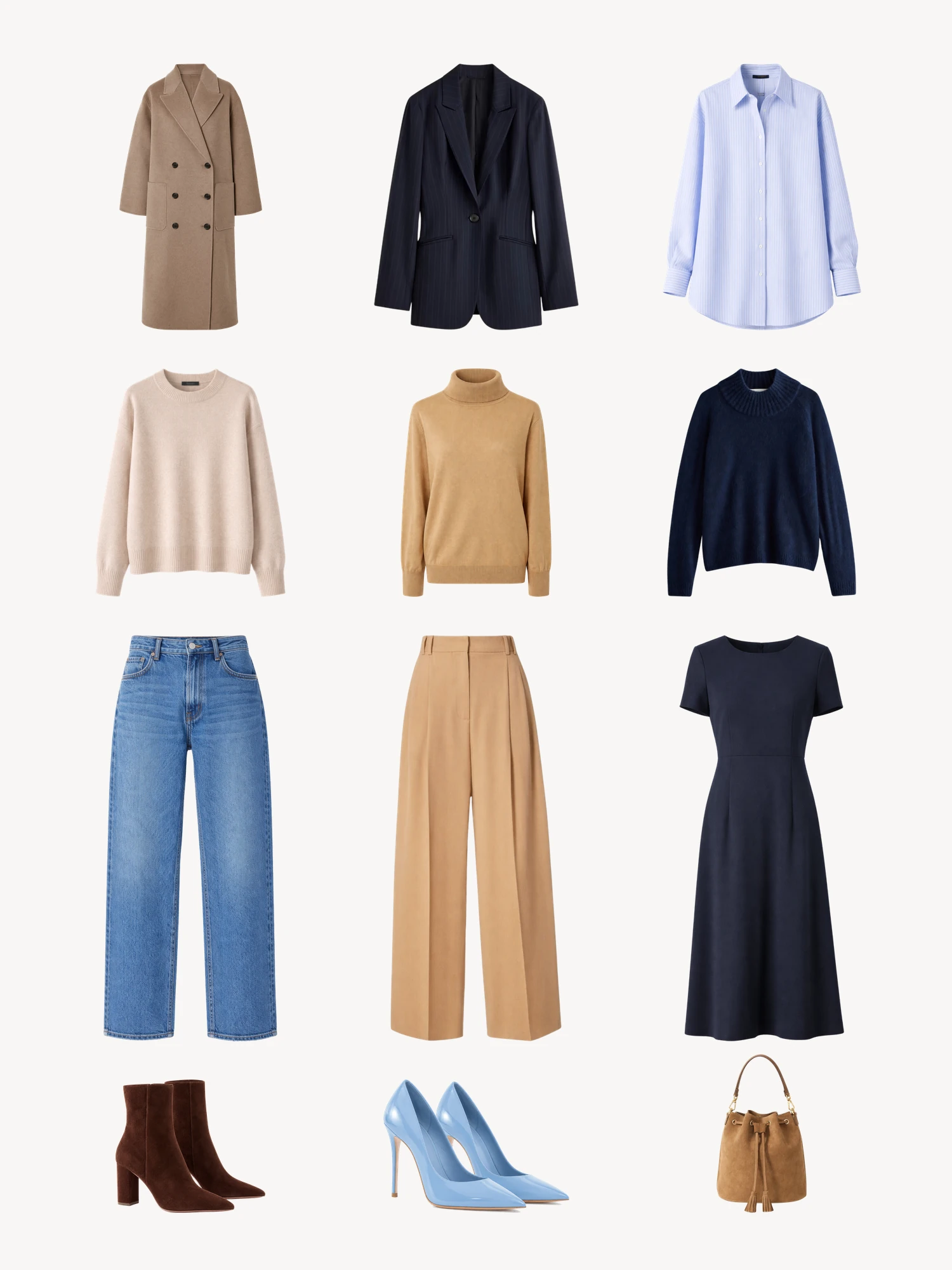
Beige long coat, navy blazer, light blue shirt, cream crew neck sweater, camel turtleneck, navy sweater, blue jeans, camel wide leg trousers, navy dress, brown suede ankle boots, pale blue pumps and camel suede bucket bag.
People are often told that a capsule wardrobe makes more outfits from fewer clothes. It sounds good. It also sounds a little like something said on the back of a cereal box. How many more outfits, exactly? From how few clothes?
So let’s actually count.
This article is a worked example. We’ll take a small set of real pieces, the kind many wardrobes already contain, and see what they really produce. Then we’ll plan ten days of getting dressed from them, without wearing the same outfit twice.
No shopping, no special pieces, no tricks. Just simple maths and a few clothes that get along.
Why ten days?
Ten days is a useful length for a capsule experiment. It’s long enough to feel like real life, with work days, weekends, a dinner or two and a change in the weather. And it’s short enough that you can try it without committing to anything.
It’s also a length that tends to reveal things. By day four or five, you know which pieces you love wearing. By day eight, you know whether anything is missing. By day ten, you’ve learned a surprising amount about your own style.
The twelve pieces
Here’s the example set: eleven clothes and shoes, and one bag. None of it is unusual. You might own something very close to most of these already, and if you don’t, swap in your own equivalents.
Four tops
- A cream crew neck sweater
- A light blue shirt
- A camel turtleneck
- A navy sweater
Two bottoms and a dress
- A pair of blue jeans
- A pair of camel wide leg trousers
- A navy dress
Two layers
- A navy blazer
- A beige long coat
Two pairs of shoes
- A pair of brown suede ankle boots
- A pair of pale blue pumps
One bag
- A camel suede bucket bag
That’s twelve pieces in total, coat included. Not counting underwear or jewellery, which you’d have anyway.
The colours are simple on purpose: navy, cream, camel and brown, with denim blue and one pale blue as the only cool notes. No black, no print. The only rule is that they all get along with each other.
Let’s count
Now the interesting part. How many outfits can these pieces make?
Bottoms and tops. Each of the two bottoms can go with each of the four tops. That’s 2 times 4, which makes 8 basic outfits.
Add the layers. Each of those 8 outfits can be worn three ways: with no layer, with the blazer, or with the coat. That’s 8 times 3, which makes 24 outfits.
Add the shoes. Each of those 24 can be worn with either pair of shoes. That’s 24 times 2, which makes 48 outfits.
Add the dress. The dress is a whole outfit on its own. With no layer, the blazer or the coat, and either pair of shoes, it adds 3 times 2, which is 6 more.
Fifty four outfits from eleven clothes and shoes.
Of course, not all 54 will be ones you’d actually wear. Some combinations won’t suit the weather or the occasion. We checked every one against two kinds of day. On a cool office day, around 13 degrees, 50 of them work: the four that don’t are the light shirt with no layer, which is too thin for the cold. On a mild weekend, around 18 degrees, 36 work: the long coat is too warm for those.
Fifty outfits for a cool week from eleven clothes. That’s more than a month and a half of getting dressed without a single repeat.
This is the real power of a capsule, and it’s worth pausing on, because most of us have never actually counted. It isn’t about having fewer clothes for the sake of it. It’s about having clothes that work together, so each piece multiplies the others.
It isn’t about having fewer clothes for the sake of it.
The ten day plan
Here’s one way to wear these twelve pieces over ten days, with no outfit repeated. Imagine a mild autumn, between 11 and 18 degrees, with work days, a weekend and an evening out. The camel bag goes with all ten.
Day one. Light blue shirt, camel trousers, navy blazer, brown boots. Crisp for the office.
Day two. Cream sweater, camel trousers, beige coat, brown boots. Soft and warm on a cool morning.
Day three. Camel turtleneck, jeans, navy blazer, brown boots. Smart, with an easy edge.
Day four. Navy sweater, camel trousers, brown boots. Simple and sharp.
Day five. Light blue shirt, jeans, navy blazer, brown boots. Friday, relaxed but put together.
Day six. Cream sweater, jeans, brown boots. A mild weekend day.
Day seven. Camel turtleneck, jeans, beige coat, brown boots. A cool morning walk.
Day eight. Navy sweater, jeans, beige coat, brown boots. A grey day at the office.
Day nine. Navy dress, navy blazer, pale blue pumps. Dinner out.
Day ten. Camel turtleneck, camel trousers, brown boots. A quiet, tonal finish.
Ten different outfits. Nine of the eleven clothes and shoes are worn at least twice, and the dress and the pumps come out once, for dinner. The jeans are worn five times and the boots nine, and nobody would ever notice, because each outfit looks different.
What makes this work
The ten day capsule works because of a few simple choices. They’re worth understanding, because they apply to any capsule you build.
Everything goes with everything. Every top works with every bottom. Both layers work over every top. The boots work with almost every outfit, and the pumps are there for the evening. This is what makes the maths possible.
The colours are friendly. Warm neutrals and navy mean nothing clashes, and the two blues give the set a little light. You could add a colour you love, as long as it works with the rest.
The layers do a lot of work. Adding or removing the blazer or the coat changes the whole feeling of an outfit, and the coat makes the cool days possible. Two layers triple the number of looks.
The pieces have different moods. There’s something relaxed, something smart, something soft and something sharp. This lets the same small set cover very different days.
The shoes change the formality. The same outfit with boots or pumps can feel like two different occasions.
What one more piece really adds
The same maths explains why some new clothes transform a wardrobe and others barely change it.
Imagine adding a fifth top to these pieces. If it works with both bottoms, both layers and both pairs of shoes, it adds 2 times 3 times 2, which is 12 new outfits. The total goes from 54 to 66.
Now imagine a fifth top that only works with one of the bottoms. It still adds outfits, but only 1 times 3 times 2, which is 6. Same space on the rail, half the use.
Shoes are even more striking. A third pair that works with everything adds a whole new version of each of the 27 outfits before shoes. That’s 27 more, taking the total to 81. In this capsule, that pair would be flat shoes or clean white trainers: they would make the weekend day and the last day lighter.
This is why the question to ask about any new piece isn’t “is it nice?” but “how many things does it go with?” A piece that connects to everything multiplies your wardrobe. A piece that connects to one thing just sits beside it.
Accessories: the free multiplier
The count above leaves out accessories, with one exception: the camel bag, which goes with all ten days. The rest are where a capsule gets its personality.
A belt, a necklace, a pair of earrings, a watch. None of them take up much room, and each can change the feeling of an outfit completely. The same jeans, cream sweater and boots look quite different with a leather belt or a bold pair of earrings.
You don’t need to count these. Just know that every accessory you add quietly turns your outfits into more outfits, and that most people already own far more of them than they wear.
Common worries
A few worries come up again and again when people first try a small capsule. They’re worth answering.
Won’t I get bored? Some people do, a little, around the middle of the ten days. Usually it passes, and many people find they enjoy the simplicity. If boredom does set in, change your accessories or swap one piece. That’s allowed.
Won’t people notice? Very rarely. Most people are far too busy with their own lives to track what you wore last Tuesday. And even if they notice the same jeans, each outfit looks different.
What about washing? With fewer pieces, you may wash a little more often. Wear layers over your tops, air knits between wears, and choose pieces that are easy to wash and dry.
What if the weather changes? That’s why the coat is part of the capsule. On cool days it goes on, on mild days it stays home, and the outfits underneath don’t change.
Making it yours
The example above is just one version. Your ten day capsule should come from your own wardrobe and your own life.
Here’s how to build yours.
Start with what you wear most. Look at the bottoms and tops you reach for again and again. They’re your foundation.
Check that they work together. Lay them out and pair every top with every bottom. If one piece doesn’t go with much, swap it for one that does.
Choose two layers. One relaxed and one smarter tends to work well. Make sure both go over all your tops.
Choose two pairs of shoes. One comfortable, one a little smarter. Both should work with most of your outfits.
Count your outfits. Multiply the numbers. Then be honest about which combinations you’d actually wear.
Plan your ten days. Write them down, or just make sure you have enough variety for your week.
Adjusting for your life
Not every life fits the same capsule. A few common adjustments:
If you dress up more often, swap the jeans for a second pair of smart trousers, or add a second smart pair of shoes.
If you dress very casually, swap the light blue shirt for another relaxed top, and the blazer for an overshirt or denim jacket.
If it’s colder, swap the light blue shirt for a fourth warm knit. The outfit count stays the same, and every top works without a layer.
If it’s hot, swap the sweaters for light shirts, and the coat for a linen layer.
If you love colour, let one or two tops be bright. As long as they work with your bottoms, they’ll add life without breaking the system.
What ten days will teach you
The most valuable part of a ten day capsule might not be the outfits at all. It’s what you learn.
You’ll probably notice that mornings are easier. When every choice works, there’s less to think about.
You’ll notice which pieces you love most. Some will feel like favourites by day three. Others you’ll be slightly relieved not to wear again.
You’ll notice if anything is missing. Maybe you wished you had a lighter pair of shoes, or one more smart top. That’s useful information.
And you might notice that you didn’t miss the rest of your wardrobe as much as you expected. That can be a quietly freeing discovery.
After the ten days
When the experiment is over, you can keep going, change a few pieces, or go back to your full wardrobe. All of those are fine.
Many people find they want to keep a version of the capsule going, because the easy mornings are so pleasant. Others enjoy returning to their full wardrobe, but with a clearer sense of which pieces really work.
Either way, the ten days will have shown you something important: that a few well chosen clothes can do far more than you thought.
Where Chloé comes in
Building a capsule like this is one of the things WATOWEAR makes much easier.
In the app, you can create a capsule from the clothes you already own, for ten days, a trip or a season. Chloé helps you choose pieces that work together and suggests outfits from that small set, so you can see how far your capsule goes without doing the maths yourself. And because she always starts from your own wardrobe, every outfit is made of clothes you already have.
Fewer pieces, more outfits
So it’s true. A capsule really does make more outfits from fewer clothes. Eleven clothes and shoes and one bag can make dozens of outfits, and ten days without a single repeat.
The secret isn’t owning special clothes. It’s choosing clothes that work together, so each one makes the others more useful.
Pick a dozen pieces from your own wardrobe. Count your outfits. Try ten days.
You might be surprised how much you already have.
- None. This piece contains no statistics or quotes. All outfit counts are worked out in the text from the example set, and the weather counts come from checking each combination against a cool and a mild day.