

How to find the pieces you forgot you owned
Why some clothes quietly disappear in your own wardrobe, and simple ways to bring them back. Before you buy anything new, go shopping in your own closet.
By Chloé Sasaa · 27 October 2026 · 11 min read
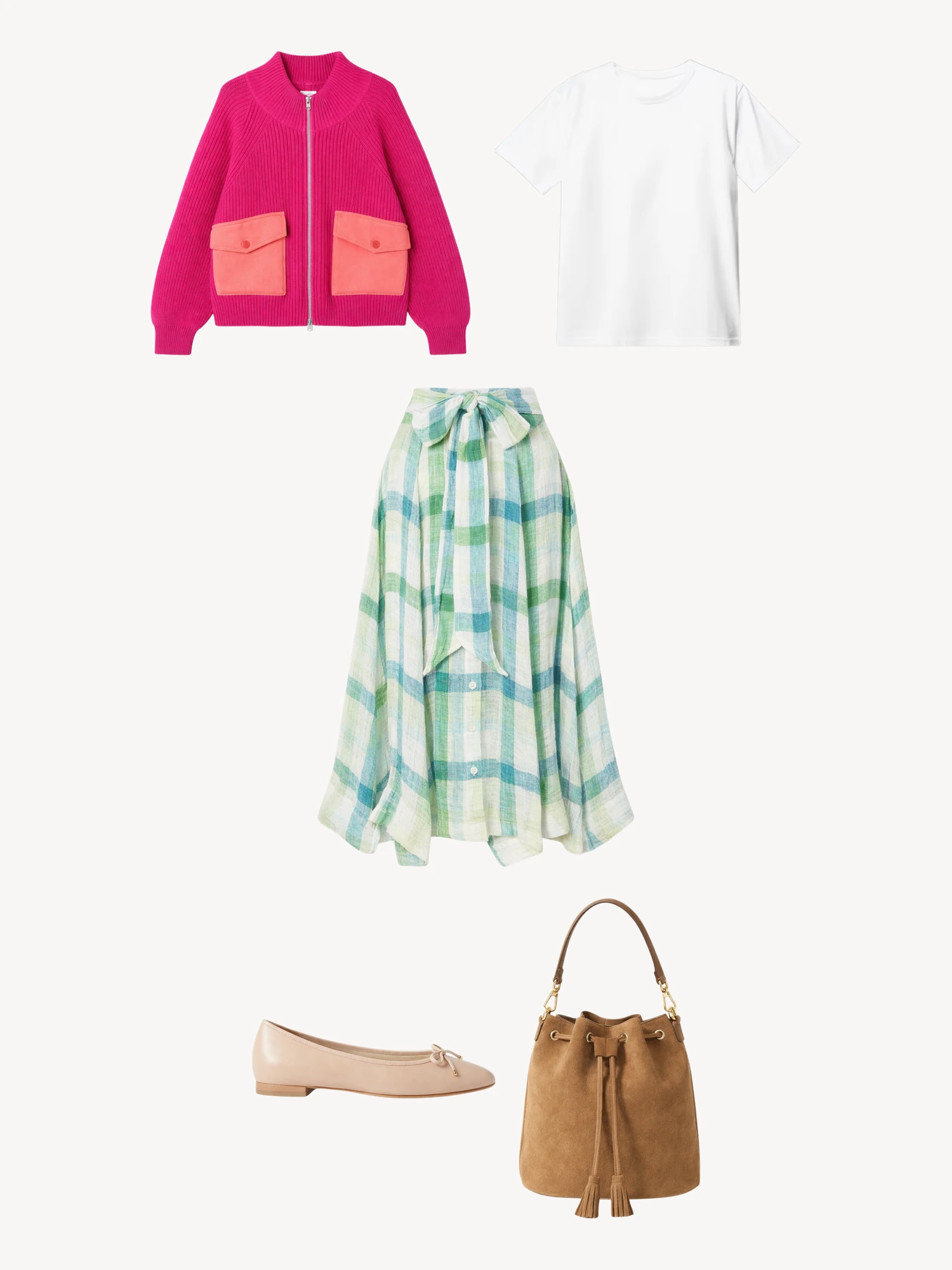
Pink knit jacket, white tee, printed midi skirt, pale ballet flats and a suede bucket bag.
Every so often it happens. You’re looking for something else, a scarf, a charger, a pair of gloves, and you find it. A top you’d completely forgotten. A jacket you loved two winters ago. A dress still with a tag on, bought for a moment that never came.
There’s a little rush of pleasure, like finding money in an old coat pocket. Oh, I love this. Why haven’t I been wearing it?
That question is worth taking seriously. Because almost everyone has clothes like this, and usually quite a lot of them. Pieces that are perfectly good, that you chose and liked, that have simply gone invisible.
This article is about why that happens, and how to bring those pieces back. It might be the most satisfying kind of shopping there is: the kind where everything is already yours.
How much goes missing
It’s easy to assume that forgetting clothes is a small, occasional thing. The research suggests otherwise.
In 2026, Vestiaire Collective surveyed more than five thousand people about their wardrobes. They found that people underestimate what’s in their own wardrobe by about 40 per cent. Nearly half of what we own simply isn’t in the picture we carry in our heads.
Nearly half of what we own simply isn’t in the picture we carry in our heads.
Older research points in the same direction. In 2012, WRAP, the UK’s waste and resources programme, studied the clothing habits of nearly eight thousand adults in a project called Valuing Our Clothes. They found that around 30 per cent of the clothing in people’s wardrobes hadn’t been worn for at least a year.
Put those together and you have a picture of most wardrobes. A busy front section of things we wear all the time, and behind it, a large quiet section we’ve partly forgotten. That quiet section isn’t a problem to feel bad about. It’s an opportunity.
Why clothes go invisible
Clothes don’t disappear because we stop liking them. Usually it’s something much more ordinary.
They’re out of sight. Things at the back of the rail, at the bottom of a drawer or in a box under the bed simply don’t come to mind. If you can’t see it, you won’t think to wear it.
Habit takes over. Most mornings, we reach for the same few things because they’re easy and safe. Over time, those pieces fill the front of our attention and everything else fades.
They never found a partner. Some pieces are lovely but don’t obviously go with anything else. So they sit there, waiting for an outfit that never quite gets put together.
They belong to a different season. Seasonal clothes get packed away and then forgotten when the season returns.
They feel too special. The beautiful piece saved for an occasion that never comes. Too nice to wear on an ordinary day, so it never gets worn at all.
They were bought for a different version of you. Sometimes we buy clothes for a life we imagined, and then they don’t fit the life we actually live.
Something small is wrong. A missing button, a loose hem, a small stain. A tiny job that keeps getting put off, and so the piece waits.
Each of these has a simple fix. And once you know why something went missing, bringing it back is often easy.
Step one: take everything out of hiding
The first step is simply to see what you have. Not all at once, which can be overwhelming, but properly.
Choose one area at a time. One rail, one drawer, one box. Take everything out and look at each piece. As you do, put the forgotten ones in a separate pile. You’ll know them when you see them, because they’ll give you that little “oh” of surprise.
Don’t make big decisions yet. You’re not deciding what to keep or let go. You’re just finding what’s been hidden.
Step two: ask why each one went missing
Look at your pile of forgotten pieces and, for each one, ask why it disappeared. Use the reasons above as a guide.
You’ll probably find that most of them fall into a few groups:
- Pieces that just need to be seen again.
- Pieces that need a partner, a new way of being worn.
- Pieces that need a small repair.
- Pieces that belong to the wrong season and need to wait.
- Pieces that genuinely don’t fit your life any more.
Only the last group is about letting go. Everything else is about bringing things back.
Step three: make them visible
The simplest fix is often the most powerful. Put forgotten pieces where you’ll see them.
Move them to the front of the rail, at eye level. Put them on top of the drawer pile. Give them a little section of their own for a few weeks, where they can’t be ignored.
When something is in front of you every morning, you’ll think about wearing it. That alone brings many pieces back into use.
A popular trick is to turn all your hangers the wrong way round. Each time you wear something, hang it back the normal way. After a few months, the hangers still facing the wrong way show you exactly which pieces have gone quiet. It’s an easy way to keep an eye on your wardrobe without keeping a list.
Step four: find each one a partner
Many forgotten pieces aren’t forgotten because they’re bad. They’re forgotten because you never worked out what to wear them with.
So take each one and try to make three outfits with it, using clothes you already wear often. Pair the forgotten top with your favourite jeans. Put the unworn skirt with the jumper you live in. Layer the neglected jacket over a simple T shirt.
You might be surprised. Often a piece that seemed impossible to wear becomes easy once it has a partner. And once you know it works with things you wear all the time, it tends to stay in rotation.
Step five: fix the small things
Some pieces have been waiting for a repair. A button, a hem, a broken zip, a small stain.
Make a little pile of these and deal with them together. Many repairs take only minutes. Others can go to a tailor or repair service in one trip. Either way, a single afternoon can bring several pieces back into your life.
It’s one of the most satisfying jobs there is. Something you’d mentally written off becomes wearable again.
Step six: wear the special things
If you have a beautiful piece you’ve been saving for the right occasion, consider making an ordinary day the occasion.
Wear the silk top with jeans. Wear the special jacket to the shops. Wear the lovely dress to lunch with a friend. Clothes saved for best often end up never worn at all, and that’s a far greater waste than wearing them on a normal Tuesday.
You deserve to enjoy your nicest clothes. They were made to be worn.
Seasonal pieces
If you store clothes by season, make a small ritual of the changeover. When you bring out the next season’s clothes, look at each piece properly rather than just putting it away.
Try things on. Remind yourself what you have. Make a few outfits. That way, your seasonal clothes come back into your attention, not just into your wardrobe.
And when you pack the previous season away, notice which pieces you didn’t wear. They might need a partner, a repair, or a decision next year.
When it really is time to let go
Sometimes, looking at a forgotten piece honestly, you realise it doesn’t belong in your life any more. It doesn’t fit, or it doesn’t suit the person you are now, or you simply don’t love it.
That’s fine. Not every piece needs to be rescued. But think about how it leaves. If it’s in good condition, it might have a whole new life with someone else. Sell it, give it to a friend, or pass it on to someone who will wear it.
Letting go of pieces you won’t wear makes it easier to see the ones you will. And if you’re not quite sure yet, put the piece in a box with a date on it. If you haven’t missed it by the time that date comes round, you have your answer, and you reached it without any pressure.
The ones with the tags still on
Almost every wardrobe has at least one. Something bought, brought home, and never worn, the label still hanging from the sleeve.
These pieces can carry a little guilt, which is part of why we avoid them. Every time you see the tag, it reminds you of a decision that didn’t quite work out. So it’s easier not to look.
Try looking anyway, kindly. Ask what you imagined when you bought it. Sometimes the answer is a life you don’t really live, and that’s worth knowing for next time. But often the answer is simply that you never found the right moment, or the right partner. Cut the tag, put it on with something you love, and wear it to something ordinary. The first wear is the hardest. After that, it’s just another piece of your wardrobe.
And if, honestly, it isn’t you, pass it on while it’s still new. Someone else will be delighted by it.
A one week rediscovery plan
If you’d like a gentle way to start, try this for one week.
Monday. Choose one rail or drawer and pull out every forgotten piece you find.
Tuesday. Wear one of them with your most reliable outfit. Just one change.
Wednesday. Make a small pile of anything that needs mending, and book or do the repairs.
Thursday. Wear a second forgotten piece, this time in a combination you’ve never tried.
Friday. Move all the rediscovered pieces to the front of your wardrobe.
Saturday. Wear something you’ve been saving for best, somewhere completely ordinary.
Sunday. Look back at the week. Which pieces felt good? Keep them in rotation. Which didn’t? Think about whether they need a partner, a repair, or a new home.
By the end of the week, you’ll have worn several pieces you’d forgotten, and your wardrobe will feel noticeably fuller.
Keeping things from going missing again
Once you’ve brought your forgotten pieces back, a few habits help stop them disappearing again.
Keep your wardrobe visible. Don’t pack it so tightly that things get lost. Leave a little space so you can see everything.
Rotate. Every so often, move pieces from the back to the front.
Try something new each week. Make one outfit with a piece you haven’t worn recently.
Buy thoughtfully. The fewer new things you bring in, the less likely older pieces are to get buried.
Where Chloé comes in
This is one of the problems WATOWEAR was made to solve.
When your clothes are in the app, they’re all in one place that you can see and search, including the ones that have drifted to the back of the rail. And because Chloé builds outfits from your whole wardrobe, she doesn’t forget the pieces you’ve forgotten. She’ll happily suggest the jacket you haven’t worn in a year, paired with things you wear every day, so it finally gets its moment.
It’s a little like having a friend who remembers everything you own, and loves finding new ways to wear it.
The best kind of shopping
Before you buy anything new, it’s worth shopping your own wardrobe first. The pieces you forgot you owned are already paid for, already chosen by you, and often exactly what you were about to go and look for.
So take things out of hiding. Ask why they went missing. Make them visible, find them partners, fix the small things, and wear the special ones.
Then enjoy the strange, lovely feeling of a wardrobe that suddenly seems much bigger, without a single thing being added.
- Vestiaire Collective consumer survey of more than 5,000 people, 2026, reported in Forbes and Retail Brew: wardrobes underestimated by about 40 per cent.
- WRAP, Valuing Our Clothes, 2012, consumer research with 7,950 UK adults: about 30 per cent of clothing unworn for at least a year.